
All roof lanterns share the same basic parts, but each frame material fails in its own way: aluminium usually needs seals, cappings and finish repairs, uPVC suffers from brittle caps and shrinking gaskets, and timber needs protection against rot. Knowing the material tells you what to look for and roughly what the repair involves.
What do all roof lanterns have in common?
Every roof lantern, whatever it's made of, uses a ridge, hip bars, glazing bars with top cappings and gaskets, an eaves beam and sealed glass units sitting on a kerb. Many larger lanterns also have tie bars across the inside to stop the eaves spreading. The materials change how those parts are made and how they age, which is why repairs differ.
What goes wrong with aluminium roof lanterns?
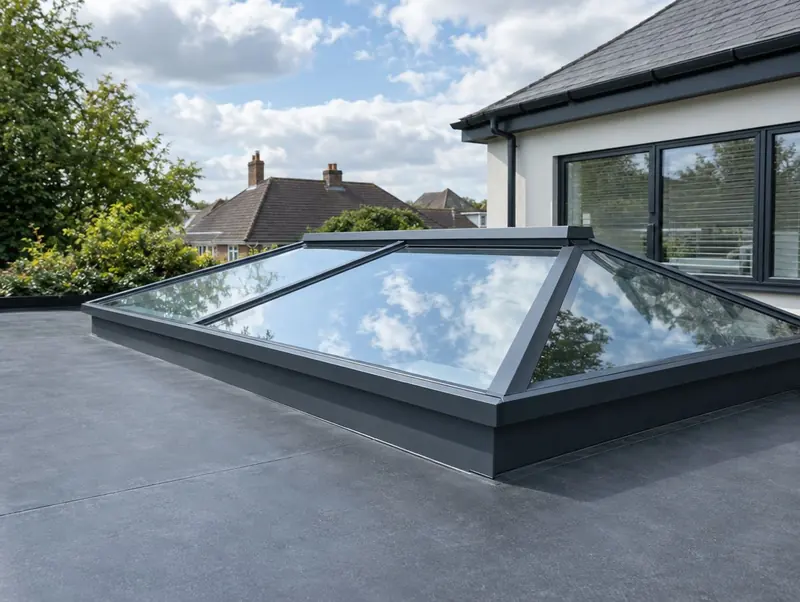
Aluminium lanterns are strong and stable, and most of their problems are with the parts attached to the frame:
- Gaskets that shrink or harden, leaving gaps at the corners of the glass.
- Clip-on or screw-fixed cappings that loosen in wind.
- Sealant at the ridge and hips that cracks with the metal's thermal movement.
- Powder-coat that chalks, fades or chips, especially on south-facing slopes.
- Corrosion at cut ends or around steel fixings near the coast.
- Cold bars and condensation on older frames with no thermal break.
Aluminium roof lantern repair usually means new gaskets, re-fixed or replaced cappings, fresh seals and finish touch-ups. Faded frames can be resprayed on site.
What goes wrong with uPVC roof lanterns?
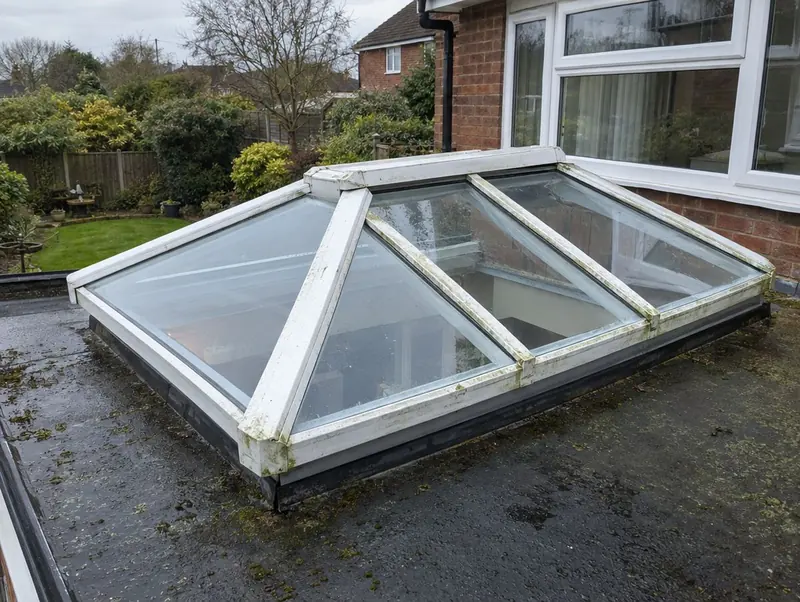
uPVC lanterns, often built around an aluminium core, are the most common type on extensions. Their weak points are the plastic parts exposed to sunlight:
- Ridge end caps and hip caps that become brittle and crack.
- External cappings that discolour, warp or pop off their clips.
- Gaskets that shrink back from the ends of the bars.
- Eaves beams whose internal drainage blocks, overflowing inwards.
- Loose fixings where the uPVC has moved against its reinforcement.
uPVC roof lantern repair mostly involves replacement caps, cappings, gaskets and seals. Parts vary between systems, so we identify the system before ordering.
What goes wrong with timber roof lanterns?
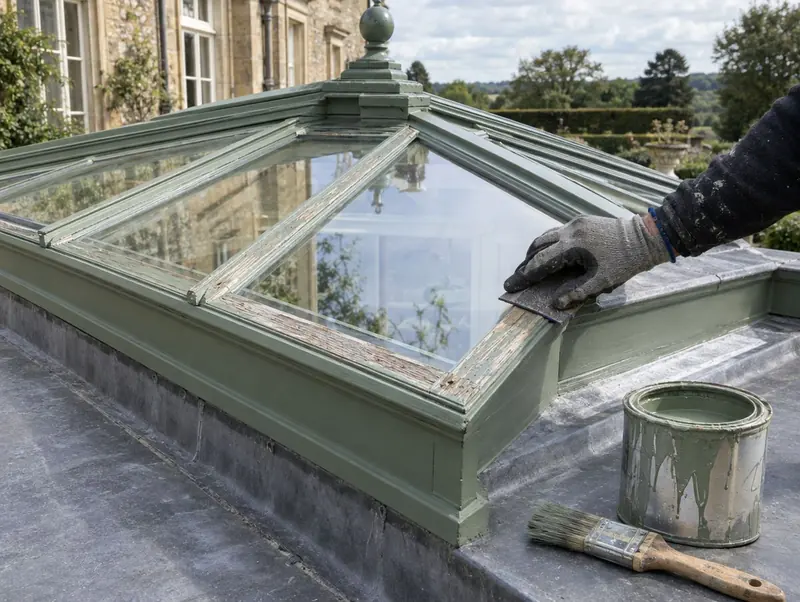
Timber lanterns, common on orangeries and period homes, look superb but depend on their paint and seals to stay dry:
- Rot at the feet of rafters, along the eaves and at joints where water sits.
- Paint that cracks and lets water into the end grain.
- Putty or beads that fail, letting water behind the glass.
- Movement that opens joints and cracks seals.
- Condensation runoff soaking the inside of the eaves.
Timber roof lantern repair can involve cutting out rot and splicing in new wood, resin repairs, new beads and seals, and redecoration. Many timber lanterns also have aluminium top cappings, which need their own seals checking.
How do the repair approaches compare?
Aluminium and uPVC repairs are mostly about parts and seals, while timber repairs add joinery and redecoration.
| Material | Typical faults | Usual repair | Guide price (ex VAT) |
|---|---|---|---|
| Aluminium | Gaskets, loose cappings, cracked seals, faded finish | Gaskets, cappings, reseal, touch-up or respray | £195–£695 per lantern |
| uPVC | Brittle end caps, popped cappings, shrunk gaskets | Replacement caps, cappings and gaskets | £175–£595 per lantern |
| Timber | Rot, failed paint, open joints | Splice and resin repairs, redecoration | £395–£1,995 per lantern |
All prices are guides; the fixed price is confirmed in writing before any work starts.
What about tie bars and structural parts?
Tie bars, the slim rods or tubes running across the inside of many lanterns, stop the eaves from spreading under the weight of the glass. They're usually aluminium or steel whatever the frame material, and they should never be removed to tidy the look. If a lantern's eaves are bowing outwards, the ridge has dropped or doors in the room below have started to stick, check that the tie bars are present and tight. On timber lanterns, rot at the point where a tie bar or rafter meets the eaves is a structural repair, not just a cosmetic one, and should be assessed before any glazing work.
Can the colour or finish be refreshed?
Yes. Aluminium and uPVC lanterns can be cleaned, prepared and sprayed on site to a chosen RAL colour, which refreshes a faded finish or changes the colour entirely. Roof lantern respraying costs £495–£1,295 ex VAT per lantern as a guide. Timber lanterns are redecorated with paint or stain systems designed for exterior joinery, which is part of the timber repair rather than a separate service.
How do you know which material you have?
Tap a bar gently from inside: timber sounds dull, aluminium rings slightly and uPVC sounds hollow. Look at the corners, as uPVC often has moulded caps and timber shows joints. If you're still unsure, photos of the inside and the ridge are usually enough for us to identify it. Send them for a free guide price, or use the guide-price tool.
Quick answers
Which roof lantern material needs the least maintenance?
Powder-coated aluminium generally needs the least, as long as the seals and drainage are looked after. Timber needs the most, because it relies on regular redecoration to stay sound.
Can you get replacement parts for an old uPVC roof lantern?
Often, yes, either from the system maker or compatible alternatives. Where an exact part is no longer made, we can usually adapt a suitable replacement.
Is a rotten timber lantern always beyond repair?
No. Localised rot can usually be cut out and spliced or resin-repaired. If rot has spread through the main structure, replacement may be more economical.
Written by the Roof Lantern Repairs team. Last updated 19 October 2026.