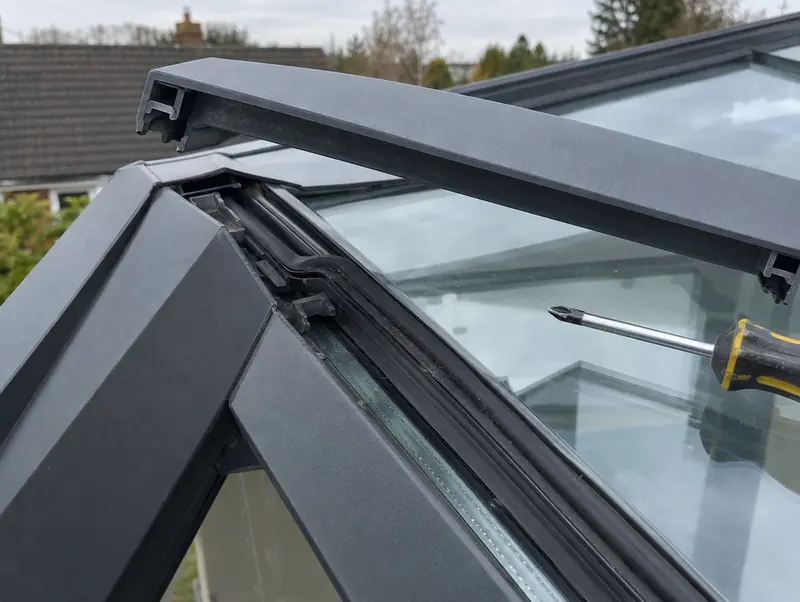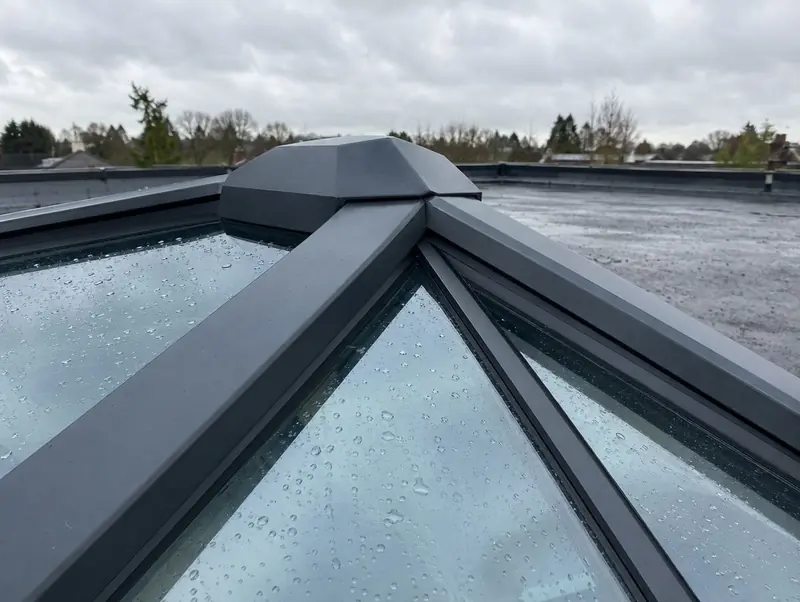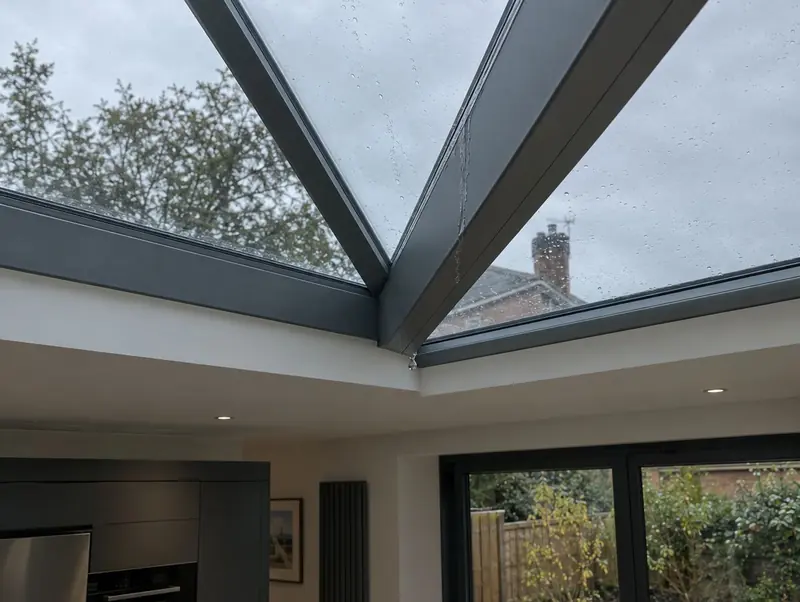
Resealing is the planned, whole-lantern version of a leak repair: we cut out the old, failed sealant, clean every joint back to a sound surface and reseal the cappings, ridge and eaves with materials that suit the frame. Done properly it is neat, durable and far cheaper than replacement.
What are the signs you need roof lantern resealing?
- Cracked, split or shrunken sealant along the bars
- Black mould or dirt lines trapped in old silicone
- Several small leaks rather than one obvious one
- Sealant applied over sealant from previous patch repairs
- A lantern that is 8–15 years old and has never been maintained
What usually causes it?
Sealant past its life
Exposed sealant on a roof takes UV, frost and constant expansion and contraction. It hardens, loses grip and pulls away from the glass.
Wrong product used
General-purpose or acetoxy silicone can fail early on some frames and coatings. Glazing joints need a low-modulus, compatible sealant.
Patch over patch
Fresh sealant run over old, dirty sealant rarely bonds. It looks fixed for a season and then lets go.
How do we fix it?
- Check what's under the sealantWe lift a capping or two to check gaskets and fixings. If the gaskets have failed, sealant alone won't fix it and we'll say so.
- Cut out and cleanOld sealant is removed, joints are cleaned and primed where the product needs it.
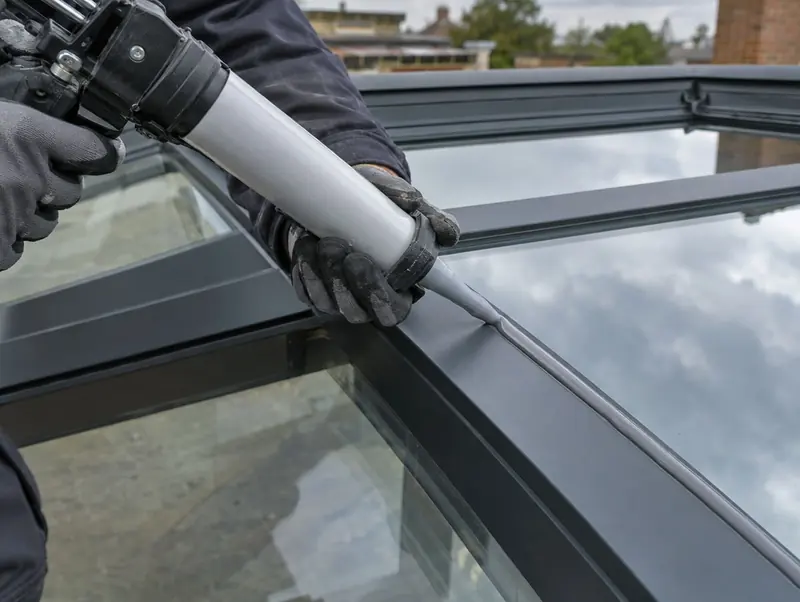
- Reseal neatlyJoints are resealed with a colour-matched, compatible sealant and tooled to shed water.
- Test and photographWe water-test and send you photos of the finished joints.
How long does a roof lantern reseal last?
It depends on exposure, the frame and the original detailing, but a properly prepared reseal with a compatible sealant should last many years. The biggest factor is preparation: sealant applied to clean, dry, sound surfaces lasts; sealant smeared over old sealant does not. Keeping the eaves drainage clear also takes pressure off the joints.
Is resealing enough, or do the gaskets need replacing?
Sealant is the last line of defence; the gaskets under the cappings do the main work. If gaskets have shrunk, hardened or slipped, we replace them while the cappings are off. We check this before quoting so you're paying for the repair that will actually hold.
What should you expect to pay for roof lantern resealing?
Guide prices assume a standard lantern on a single-storey roof with safe ladder access. Where a tower or scaffold is needed we add it to the quote (typically £245–£895 ex VAT). Diagnostic visits start from £145 ex VAT. Your fixed price is confirmed in writing before any work starts. See all guide prices.
Where is this on the lantern?
Highlighted in amber: glazing bars, cappings and gaskets.
Questions about roof lantern resealing
How much does it cost to reseal a roof lantern?
A standard-size lantern on a single-storey extension is usually £245–£495 ex VAT. Larger lanterns, difficult access or gasket replacement add to that, and you get the fixed price in writing first.
Can you match the colour of my frame?
We use sealants in common frame colours such as anthracite grey, black and white, and match as closely as the range allows.
How long does resealing take?
Most domestic lanterns take a few hours in dry weather.
Where do we carry out roof lantern resealing?
We cover the whole of the UK. Choose your area for local details and towns we cover.
England
- Bedfordshire
- Berkshire
- Bristol
- Buckinghamshire
- Cambridgeshire
- Cheshire
- Cornwall
- Cumbria
- Derbyshire
- Devon
- Dorset
- County Durham
- East Riding of Yorkshire
- East Sussex
- Essex
- Gloucestershire
- Greater London
- Greater Manchester
- Hampshire
- Herefordshire
- Hertfordshire
- Isle of Wight
- Kent
- Lancashire
- Leicestershire
- Lincolnshire
- Merseyside
- Norfolk
- North Yorkshire
- Northamptonshire
- Northumberland
- Nottinghamshire
- Oxfordshire
- Rutland
- Shropshire
- Somerset
- South Yorkshire
- Staffordshire
- Suffolk
- Surrey
- Tyne and Wear
- Warwickshire
- West Midlands
- West Sussex
- West Yorkshire
- Wiltshire
- Worcestershire
Wales
Scotland
- Aberdeen and Aberdeenshire
- Highlands and Islands
- Moray
- Dundee and Angus
- Perth and Kinross
- Fife
- Edinburgh and the Lothians
- Glasgow and Clyde
- Lanarkshire
- Ayrshire
- Stirling and Falkirk
- Dumfries and Galloway
- Scottish Borders
- Argyll and Bute