
A leak near a roof lantern can come from the lantern, the kerb junction where the flat roof meets it, or the flat roof itself some distance away, because water often travels inside a roof before it shows. Where and when the water appears, and how long it continues after rain, usually point to which one it is.
Why is it hard to tell where the water is coming from?
It's hard to tell because water rarely drops straight down from where it enters. On a flat roof it can get under the covering, run along the deck or a joist and appear a metre or more away, often at the lantern opening because the plasterboard edge there is the easiest exit. Meanwhile a lantern leak can run down a bar and drip from the eaves, looking like a kerb problem. The three possible sources are the lantern itself, the junction between the roof covering and the kerb, and the flat roof covering elsewhere.
What signs point to the lantern?
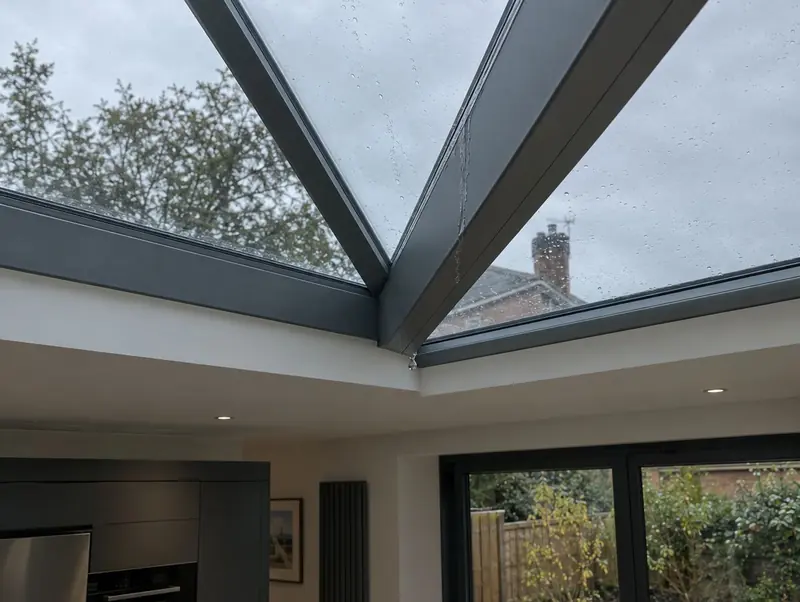
A leak that drips from the glass or bars during rain, and stops soon after, usually comes from the lantern.
- Drips from the glass, bars or ridge rather than from the plaster.
- Water that appears during rain and stops soon after it eases.
- Leaks linked to wind from one direction.
- Visible faults such as a lifted capping, cracked end cap or open sealant joint.
- Debris piled in the eaves channel or against the glass.
These point to a roof lantern leak repair rather than roofing work.
What signs point to the kerb junction?
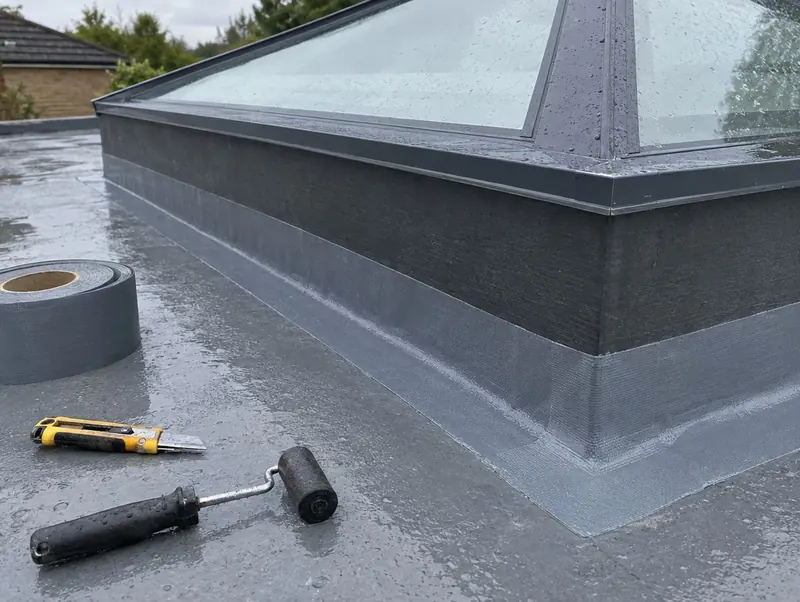
Water appearing on the sides of the opening, rather than from the glazing, usually points to the kerb junction.
- Damp or staining on the inside faces of the opening, especially at the corners.
- Water running down the reveal rather than dripping from the glass.
- Ponding on the roof against one side of the kerb.
- Membrane that is split, lifted or stops short of the top of the upstand.
Junction faults are covered in detail in our guide to upstand and kerb leaks.
What signs point to the flat roof itself?
Leaks that spread beyond the opening or linger long after rain usually come from the wider flat roof.
- Staining on the ceiling away from the lantern as well as near it.
- Drips that carry on for hours or days after rain, as water soaked into insulation slowly drains.
- A roof that ponds widely, has blisters, splits or cracked joints in the covering.
- Leaks around other penetrations: soil pipes, extractor outlets, gutters or wall abutments.
- An ageing felt or GRP roof that is near the end of its life.
What can you check before calling anyone?
A few observations from inside and from the ground make diagnosis far quicker:
- Mark the edge of any ceiling stain with a pencil and date it, so you can see whether it grows after the next rain.
- Note how long the drip continues once the rain has stopped: minutes, hours or days.
- From an upstairs window, photograph the roof during or just after rain to show where water ponds.
- Check whether the roof outlets and gutters are clear and taking water away.
- Look at other things that pass through the roof, such as vent pipes or flues, for cracked seals.
Please don't walk on the flat roof to look. Even if the deck is strong, the lantern and its glass are fragile, and roof edges are unguarded.
How do different flat roof coverings fail around a lantern?
Each type of flat roof covering has its own weak point where it turns up the lantern kerb.
| Covering | Typical failure near a lantern |
|---|---|
| EPDM rubber | Lapped joints or corner patches debonding; trims letting water behind the membrane |
| GRP fibreglass | Cracks at the internal corners of the kerb and at trim joints from movement |
| Felt | Splits, blistering and failed upstand dressings as the felt ages |
| Single-ply | Failed welds at corners and inadequate termination at the top of the upstand |
The junction at the kerb is often the weakest part of any of these roofs, because it has the most corners and the most movement.
How is the source confirmed?
A leak investigation follows a logical order: check the lantern's cappings, seals and drainage; examine the junction, trims and corners; then look at the wider roof. Where the cause still isn't certain, controlled water testing wets one area at a time, starting low on the roof and working up, while someone watches inside. That isolates the source and avoids paying for repairs in the wrong place. The visit is £145–£295 ex VAT as a guide, including a written report.
Who should fix it?
If the fault is in the lantern, a lantern repair specialist fixes it. If it's in the general flat roof, a roofer is the right trade. The junction sits between the two, and that's where problems arise when each trade assumes the other is responsible. We repair lanterns and their kerb junctions, including flat-roof junction repair (£245–£695 ex VAT) and upstand and kerb repair (£395–£1,295 ex VAT) as guides. If we find the main roof is the problem, we'll tell you plainly. Send photos for a free guide price or try the guide-price tool; the fixed price is confirmed in writing before any work starts.

Quick answers
Can a flat roof leak show up at the roof lantern?
Yes, often. Water can enter some way from the lantern, run along the deck or joists and appear at the opening because the edge of the ceiling there gives it an easy way out.
How long after rain should a lantern leak stop?
Leaks through the lantern itself usually stop soon after the rain does. Drips that carry on for a long time point to water soaked into the kerb or the roof build-up.
Is water testing messy or damaging?
It's controlled and limited to small areas at a time, with someone watching inside so testing stops as soon as water appears. It doesn't involve flooding the roof.
Written by the Roof Lantern Repairs team. Last updated 19 October 2026.