
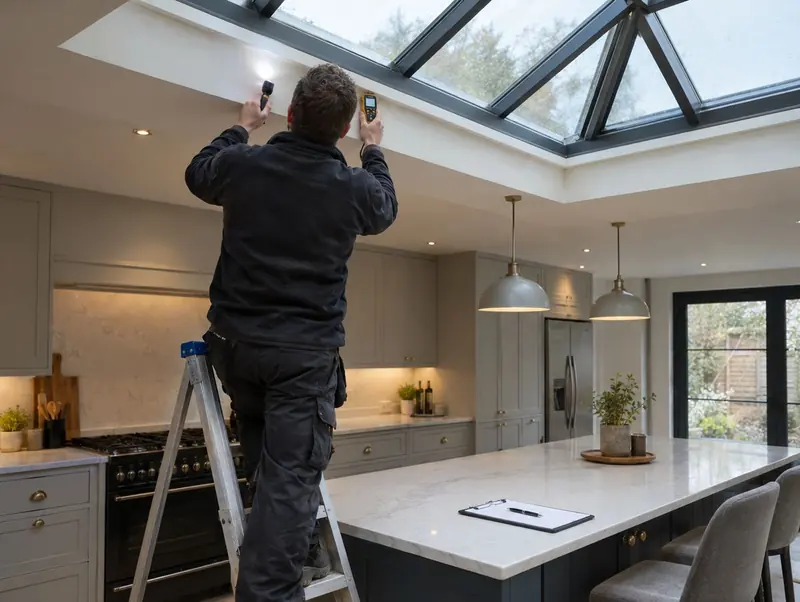
A roof lantern upstand or kerb is leaking when water gets past the flat roof covering where it turns up the kerb, or between the top of the kerb and the lantern's eaves. Tell-tale signs are damp or stained plaster around the base of the opening rather than drips from the glass.
What is a roof lantern upstand or kerb?
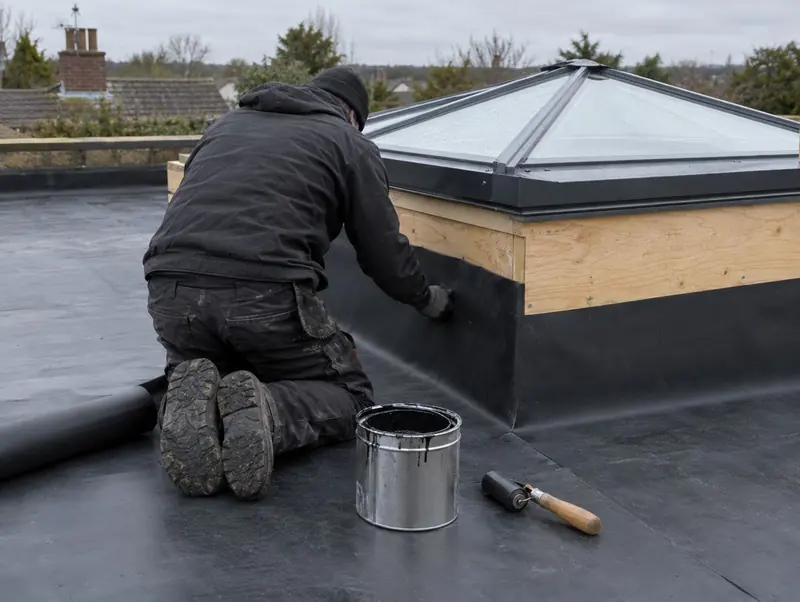
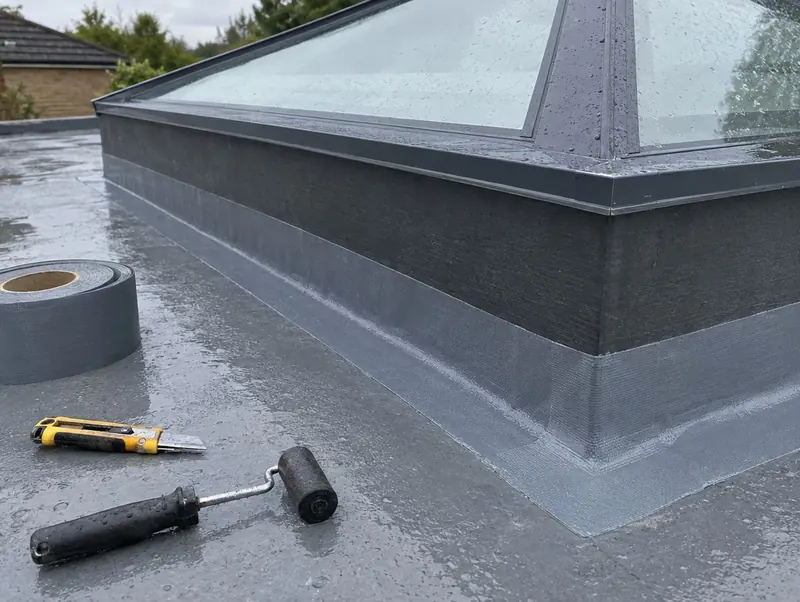
The upstand, or kerb, is the raised frame that lifts the lantern above the flat roof so rainwater runs past it instead of into it. It may be built on site from timber and insulation, supplied as a factory-made insulated kerb, or formed in masonry. The flat roof covering, whether EPDM rubber, GRP fibreglass, torch-on felt or a single-ply membrane, is dressed up the outside of the kerb and finished at the top, and the lantern's eaves beam sits on the kerb and laps over that finished edge.
What are the signs of a kerb or junction leak?
The main sign of a kerb or junction leak is damp around the base of the opening while the glass stays dry.
- Damp, bubbling or stained plaster on the inside faces of the opening, or on the ceiling just around it.
- Water appearing at the base of the opening while the glass and bars look dry.
- A leak that carries on for hours or days after the rain stops, because water soaked into the kerb insulation is slowly draining.
- Puddles on the flat roof that sit against one or more sides of the kerb.
- Soft or swollen timber trims, or plasterboard linings that feel spongy.
- Mould along the reveals, which can also be a sign of a cold kerb with condensation.
Why do roof lantern kerbs leak?
Most kerb leaks come from how the flat roof and the lantern were joined:
- Membrane not dressed high enough up the kerb, or stopped short of the top so water can get behind it. The covering needs to turn up well clear of the finished roof surface so that splashing and standing water can't reach its top edge.
- Poor falls on the flat roof that send water towards the lantern, where it ponds against the kerb.
- Debonded or split membrane at the corners, which take the most movement and are the hardest to detail.
- Missing or badly fitted trims, so water runs behind the membrane instead of over it.
- Lantern not lapping over the top of the membrane, leaving an open joint under the eaves beam.
- Fixings driven through the membrane on top of the kerb without sealing.
- Rotten timber in an older kerb, so nothing holds the membrane or the lantern firmly.
Is it the kerb, the eaves beam or the glass?
The eaves beam sits directly on the kerb, so faults there can look alike. A blocked eaves drainage channel overflows inwards and soaks the top of the kerb from above, while a kerb fault lets water in from the outside face. We check the eaves channel and weep slots first, because clearing them is cheap, then examine the membrane, trims and corners. Where it's still unclear, controlled water testing one area at a time isolates the source. Our guide on flat roof versus lantern leaks covers the wider picture.
How is a leaking kerb repaired?
The repair depends on what we find when the junction is opened up:
- Junction faults only – the membrane is re-dressed or patched with compatible material, trims refitted and corners re-formed. This is a flat-roof junction repair.
- Wet but sound kerb – it's opened, allowed to dry where possible, re-insulated and re-covered.
- Rotten or undersized kerb – the lantern is lifted off temporarily, the kerb rebuilt or replaced with an insulated kerb at the right height, and the roof covering properly dressed before the lantern is refitted. This is an upstand and kerb repair.
Should the kerb be insulated?
Yes. A poorly insulated kerb is a cold band around the base of the opening, which encourages condensation and mould on the reveals. In England, Approved Document L sets a maximum U-value of 0.35 W/m²K for an upstand built on site as part of a rooflight installation, and a rebuilt kerb should be insulated to suit. Other UK nations have their own energy standards, which we follow where the work is done.
How much does kerb and junction repair cost?
As a guide, flat-roof junction repairs cost £245–£695 ex VAT per lantern and upstand or kerb repairs £395–£1,295 ex VAT per lantern, depending on size, the roof covering and how much timber needs replacing. If the cause isn't clear, a leak investigation starts from £145 ex VAT. Send photos of the roof and the damp patches for a free guide price, or try the guide-price tool; the fixed price is confirmed in writing before any work starts.
Quick answers
Can a kerb be repaired without removing the lantern?
Often, if the fault is in the membrane or trims and the timber is sound. A rotten or too-low kerb usually means lifting the lantern off temporarily so the kerb can be rebuilt properly.
Why does my lantern still drip days after the rain has stopped?
Water that has soaked into the kerb or the roof insulation drains out slowly, so the drip carries on long after the rain. That pattern points strongly to a kerb or flat-roof fault rather than the glazing.
Who should repair the kerb, a roofer or a lantern specialist?
The junction involves both trades, so it helps if one team takes responsibility for the lantern, kerb and membrane together. That way nobody can blame the other side of the joint.
Sources
Written by the Roof Lantern Repairs team. Last updated 19 October 2026.