
A roof lantern usually leaks because water is getting past a failed seal, gasket or capping, through a cracked ridge end cap, or over a badly detailed kerb where the flat roof meets the lantern. Some apparent leaks are really condensation, so the first job is always to work out where the water is actually coming from.
Which parts of a roof lantern keep the rain out?
A roof lantern keeps water out through a chain of overlapping seals, and a leak means one link in that chain has failed. Aluminium, uPVC and timber lanterns all share the same basic anatomy:
- Ridge and ridge end caps – the horizontal spine along the top, finished with moulded caps where the hips meet it.
- Hip bars – the corner rafters running from each end of the ridge down to the corners.
- Glazing bars – the intermediate rafters. Each has a top capping that clamps the glass onto gaskets.
- Eaves beam – the perimeter frame at the foot of the slopes. Many include an internal drainage channel with weep slots that let water escape onto the roof.
- Sealed glass units – double or triple glazed panels with a spacer bar and desiccant between the panes.
- Upstand or kerb – the raised base the lantern sits on, with the flat roof membrane dressed up its sides.
Water that gets past an outer capping is meant to be caught by the gaskets and drained out at the eaves. Leaks start when that back-up route is blocked or bypassed.
What are the most common causes of a roof lantern leak?
In most cases the cause is one of a short list of faults:
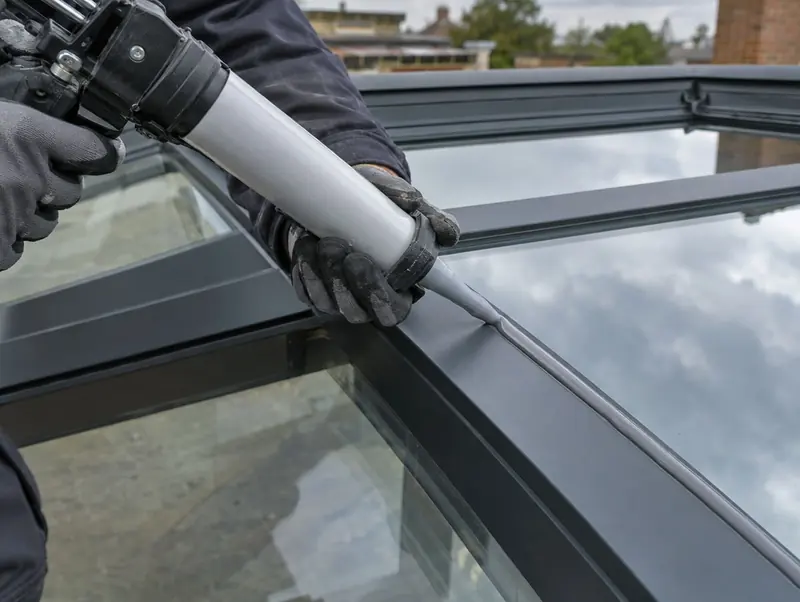
- Failed sealant or tape along the ridge, hip caps or eaves, usually after long exposure to sun and frost.
- Perished or shrunken gaskets that no longer press on the glass, leaving a gap at the top or bottom of a bar.
- Lifted or missing cappings, often after high winds, especially clip-on caps.
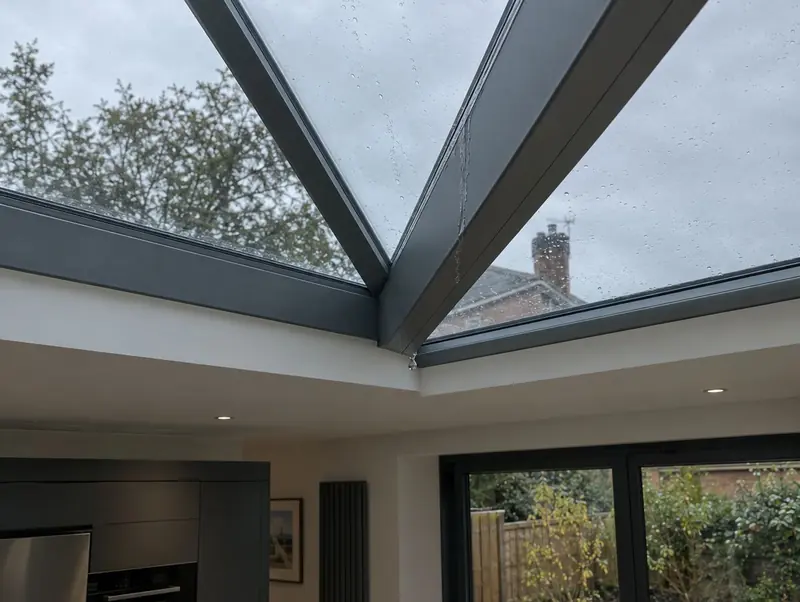
- Cracked ridge end caps, which become brittle with age and UV and let water straight into the ridge.
- Blocked eaves drainage – leaves, moss and grit fill the channel and weep slots, so water backs up and spills inwards.
- Slipped glass that has crept down the slope and opened a gap at the ridge.
- Kerb and flat-roof junction faults, such as a membrane that stops short of the top of the upstand or a roof that ponds against the kerb.
Does the position of the drip show where the leak is?
The position of the drip is a clue rather than an answer, because water often runs along a bar or a joist before it falls. Even so, some patterns are reliable:
- Drips from the middle of a glazing bar usually point to the capping or gasket on that bar.
- Water near the top of the lantern often comes from the ridge or an end cap.
- Staining on the plastered reveal around the base usually means the eaves drainage, the kerb or the flat-roof junction, not the glazing.
- A leak that only shows in wind-driven rain from one direction tends to be a capping or seal on that side.
Note when it happens, how heavy the rain was and which way the wind was blowing. Those details shorten a leak investigation considerably.
Could it be condensation and not a leak?
Yes, and it's one of the most common mix-ups. Condensation forms when warm, moist room air meets the cooler glass and frame, then runs down and drips from the bars or eaves. It tends to appear on cold mornings, after cooking or showers, or when laundry is drying indoors, even when it hasn't rained. A true leak follows rain. If water appears after several dry days, read our guide on roof lantern condensation before booking a leak repair.
Why do leaks often start a few years after installation?
Roof lanterns move. Aluminium and uPVC expand in summer sun and contract on frosty nights, and every cycle works at the sealant joints. UV light hardens silicone and gaskets until they shrink away from the glass. Wind can unclip a capping just enough for water to track underneath. Meanwhile debris builds up in the eaves channel, and nobody notices until a downpour overwhelms it. None of this means the lantern was badly made, although fitting shortcuts, such as missing setting blocks or a low kerb, bring the problems forward.
What should you do first, and what should you avoid?
Contain the water from inside, keep it away from electrics and record what you see, but stay off the roof.
- Do put down towels or a bucket and keep the water away from electrics. If it's near light fittings, switch that circuit off at the consumer unit if it's safe to do so and call an electrician.
- Do take photos and short videos of where the water appears, plus any shots of the outside you can take safely from a window or the ground.
- Don't climb onto the flat roof or lean a ladder against the lantern. The glass and bars are not designed to take a person's weight.
- Don't run fresh silicone over every joint. Over-sealing often blocks the weep slots and drainage channels the lantern relies on, which makes leaks worse and harder to trace.
How is a roof lantern leak fixed, and what does it cost?
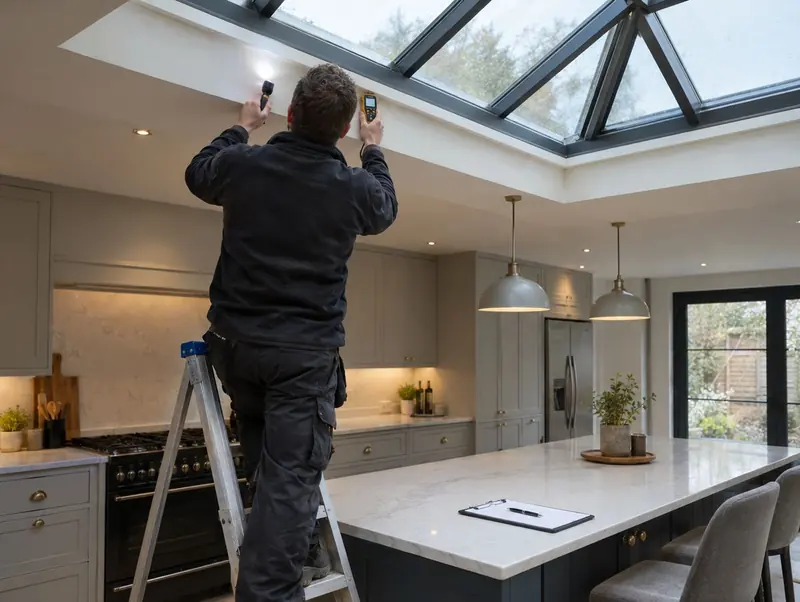
Most leaks are fixed by cutting out old sealant, re-seating or replacing gaskets and cappings, sealing the ridge and hips, and clearing the eaves drainage. As a guide, roof lantern leak repair typically costs £195–£595 ex VAT per lantern, and a full reseal £245–£495 ex VAT. Where the cause isn't obvious, a diagnostic visit starts from £145 ex VAT. Send us photos for a free guide price, or try our guide-price tool. Whatever the job, the fixed price is confirmed in writing before any work starts.
Quick answers
Can I fix a leaking roof lantern myself?
Checks from inside are fine, but most fixes involve working on the roof and removing cappings, which isn't safe without proper access equipment. Silicone smeared over the outside often blocks the drainage and makes the leak harder to trace later.
Does a leaking roof lantern need replacing?
Usually not. Most leaks come from seals, gaskets, cappings or blocked drainage, all of which can be repaired; replacement is mainly worth considering when the frame itself has failed.
Why does my lantern only leak in heavy rain?
Heavy rain fills the eaves drainage channel faster than a partly blocked weep slot can empty it, so marginal faults only show in a downpour. If it only happens with wind from one direction, suspect a capping or seal on that side.
Sources
Written by the Roof Lantern Repairs team. Last updated 19 October 2026.