
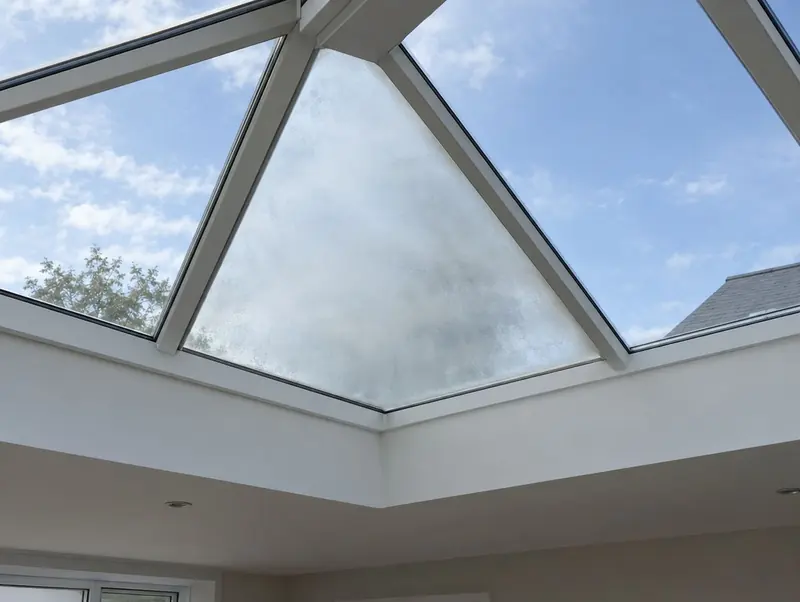
Misting between the panes of a roof lantern means the sealed glass unit's edge seal has failed and moist air has got into the cavity between the panes. It can't be wiped or cleaned away, but it can be fixed by replacing just the affected glass unit, usually without touching the frame.
What causes misting inside a roof lantern glass unit?
Misting inside a glass unit is caused by a failed edge seal letting moist air into the sealed cavity. Each unit is two or three panes held apart by a spacer bar around the edge. The spacer is filled with desiccant, a drying agent that soaks up any moisture trapped during manufacture, and the whole edge is closed with a primary and secondary seal. Once the seal fails, humid air seeps in, the desiccant becomes saturated, and moisture condenses on the inside faces of the glass whenever the temperature drops.
Why do roof lantern units fail sooner than windows?
Roof lantern glass has a harder life than a vertical window:
- More sun and heat. Glass facing the sky heats up more, and the daily expansion and contraction stresses the edge seal.
- Standing water. If the eaves drainage is blocked, the bottom edge of each unit can sit in water, which attacks the seal.
- Missing setting blocks. Units resting directly on the frame, or sliding down the slope, put uneven load on the edge.
- Incompatible sealant. Some sealants react with the unit's edge seal and soften it.
- Age. Every edge seal eventually lets moisture in; heat and water simply speed it up.
How can you tell misting between the panes from surface condensation?
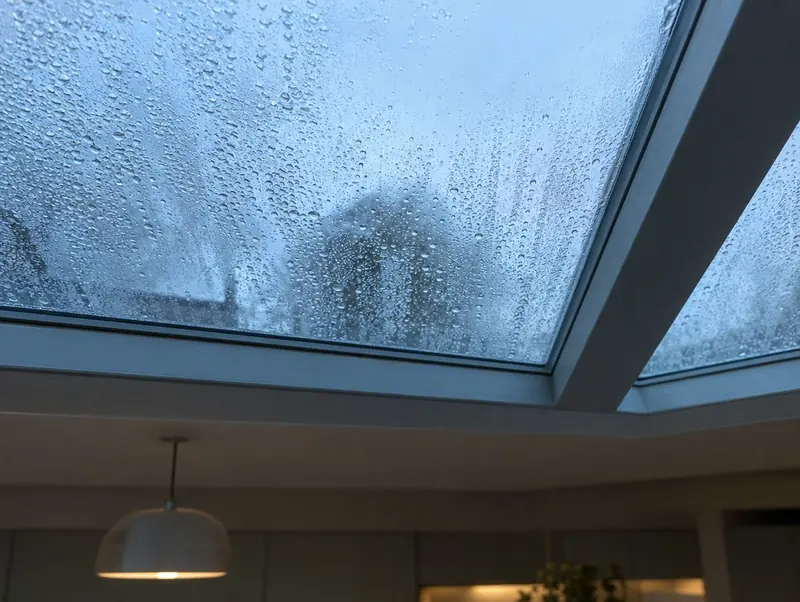
Wipe the glass. If the moisture is on the room-side surface, it will clear, and the cause is room humidity; see our guide on roof lantern condensation or our condensation fixes service. If it won't wipe from either side, it's inside the unit. Other signs of a failed unit are white streaks or tide marks that stay when the mist clears, a hazy look on sunny afternoons, and mist that comes and goes with the weather. Dew on the outside of the glass on a cold morning is different again: it's normal for well-insulated glass.
Can misted roof lantern glass be repaired without replacing it?
Not reliably. Drill-and-dry demisting services exist, but they don't restore the edge seal, the inert gas fill or the original insulation, and we don't recommend them for overhead glazing. Replacing the sealed unit is the dependable fix. The good news is that the frame, cappings and other units stay where they are, and only the failed unit is changed.
Does a misted unit make the room colder?
Usually a little, yes. Most modern units rely on a sealed gas fill, often argon, and a low-emissivity coating on an inner face to slow heat loss. Once the seal has failed, the gas gradually escapes and is replaced with ordinary damp air, so the unit insulates less well than when it was new. On a lantern, where the glass is a large share of the roof area, that shows up as a cooler spot overhead in winter and more condensation on the room side. The bigger problem tends to be appearance: mineral staining inside the cavity can become permanent, so even if the misting stops in summer, the glass never looks properly clear again.
What happens when a misted unit is replaced?
Replacing a misted unit means making a new unit to the exact size, then swapping it in with the cappings removed.
- We measure the unit and note its thickness, so the new one fits the existing gaskets and cappings.
- The new unit is made to order, so there's a lead time between measuring and fitting.
- On fitting day the cappings on either side are removed and the old unit is lifted out.
- We check the eaves drainage, the setting blocks and the end stop, and fix anything that caused or worsened the failure.
- The new unit goes in on fresh setting blocks, with new gaskets where needed, and the cappings and seals are renewed.
Should you upgrade the glass while you're at it?
A replacement unit is the cheapest moment to improve the specification. Worth considering:
- A laminated inner pane, which holds together if it breaks. See laminated vs toughened glass.
- Solar control glass if the room overheats in summer.
- A self-cleaning outer pane to reduce how often the glass needs washing.
- Warm-edge spacers, which reduce cold spots and condensation around the edge of the glass.
How much does replacing a misted unit cost?
As a guide, misted glass unit replacement costs £245–£595 ex VAT per unit, depending on size, glass specification and access. A solar control upgrade is £345–£895 ex VAT per unit. If several units have failed, they're usually changed on one visit to share the access cost. Send photos for a free guide price, or try our guide-price tool; the fixed price is confirmed in writing before any work starts.

Quick answers
Is misted roof lantern glass dangerous?
Not in itself. It reduces insulation and spoils the view, but the glass is no weaker; a cracked unit is a different matter and should be dealt with sooner.
Will the misting get worse?
Usually, yes. Once the desiccant is saturated, the mist appears more often and mineral streaks build up on the inside faces of the glass.
Do I need to replace all the glass if one unit is misted?
No. Each unit is sealed separately, so only the failed one needs replacing, although units of the same age may follow over the next few years.
Sources
Written by the Roof Lantern Repairs team. Last updated 19 October 2026.